
THE BIG IDEA
Of all the (many) double-binds that ensnare HR, perhaps the most difficult to overcome is the credibility trap.
This can be summarized:
Until HR is perceived as credible it will not be welcomed as a champion of change, however HR will not be perceived as credible until it has championed change.
This double-bind underpins much of the navel-gazing behavior in the function – for example, our perpetual focus on “earning a seat at the table”.
Unfortunately, this double-bind is so widespread and pernicious that it has become a crutch to victimhood and learned helplessness for many HR leaders.
It feels like such a tough nut to crack.
(in fact, many CHROs resort to surviving/performing based upon their INDIVIDUAL credibility – i.e. how they themselves deliver support to the CEO/Exec team – rather than building FUNCTIONAL credibility)
The net result is an HR function waiting for permission to act and a business that continues to see HR not stepping up.
This is the nature of double-binds and how, over time, they become accepted as part of the status quo, table stakes, or a tax on productive energy.
Thankfully, it doesn’t have to be this way.
You see, we get caught lamenting that we are perceived as non-credible, when the secret is in the second clause: … HR will not be perceived as credible until it has championed change.
Said simply:
Champion change successfully so that you EARN credibility.
TRY THIS
I’ve said it before, and I’ll say it again
(and, if you ask nicely, I’ll put on my best Dick Van Dyke “Cor blimey, Mary Poppins!” accent and dance around a rooftop while singing it aloud)
All competitive advantage comes from PEOPLE, TEAMS, ORGANIZATION and CULTURE.
It really is as simple as finding one area where you can effect change. Doesn’t have to be seismic change, any change will do.
Said differently, pick your horse: People, Teams, Organization or Culture.
Side note: depending on where you’re at in building your functional credibility, you may want to hold off from choosing Organization or Culture
(and, in fact, the latter demands the highest level of pre-existing credibility to effect change)
Now, in your one area, identify one (only one, no more, no less) change that would be likely to increase productivity, performance or value.
For PEOPLE, it may be better management of email, or handling remote work, or using more of their strengths more of the time…
For TEAMS, it might be the quality of meetings, or follow-up on agreed actions, or increasing social capital within the team…
Now, for your one change in one area, identify a meaningful intervention/solution that HR can deliver. Something that has high potential to make a difference.
Build the pilot, run it – in stealth mode, if necessary – capture the results, learn the lessons, report out
(and yes, kill it if it falls flat)
and EARN some credibility.
Extend your wins, rinse-and-repeat…
In many ways, what I’m describing is applying the lessons of entrepreneurship to HR:
- Understand your market
- Identify a pain point
- R&D a solution
- Test the solution
- Sell the solution more widely
(this is a crude list, and doesn’t include the iterative loop that goes around from R&D to testing)
And it may seem obvious, but HR perpetually gets stuck in the Understand/Identify part of the cycle
(sadly, I’ve been part of too many “I would… if only…” discussions in HR and the net result is the resistance: “unless we can change everything we can’t change anything!”)
The trick for HR change agents then is simply to act like entrepreneurs and try things.
How to do that really is as simple as what I’ve laid out above.
That said, simple doesn’t mean easy, and it doesn’t mean that you won’t face a backlash from within the function – but that is another discussion for another day.
For now, let’s look at how to move past understanding your market by identifying a pain point, and designing a workable solution.
USE THIS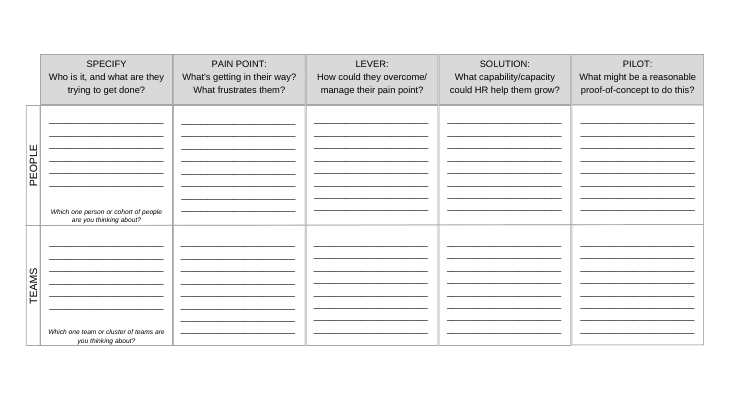 Download as PDF
FOOD FOR THOUGHT
“Take calculated risks. That is quite different from being rash” ~Gen. George S. Patton